From Dual Enrollment at 15 to Yale Medical School: RCC Alumna Saira Gupta’s Fast-Tracked Path in Medicine
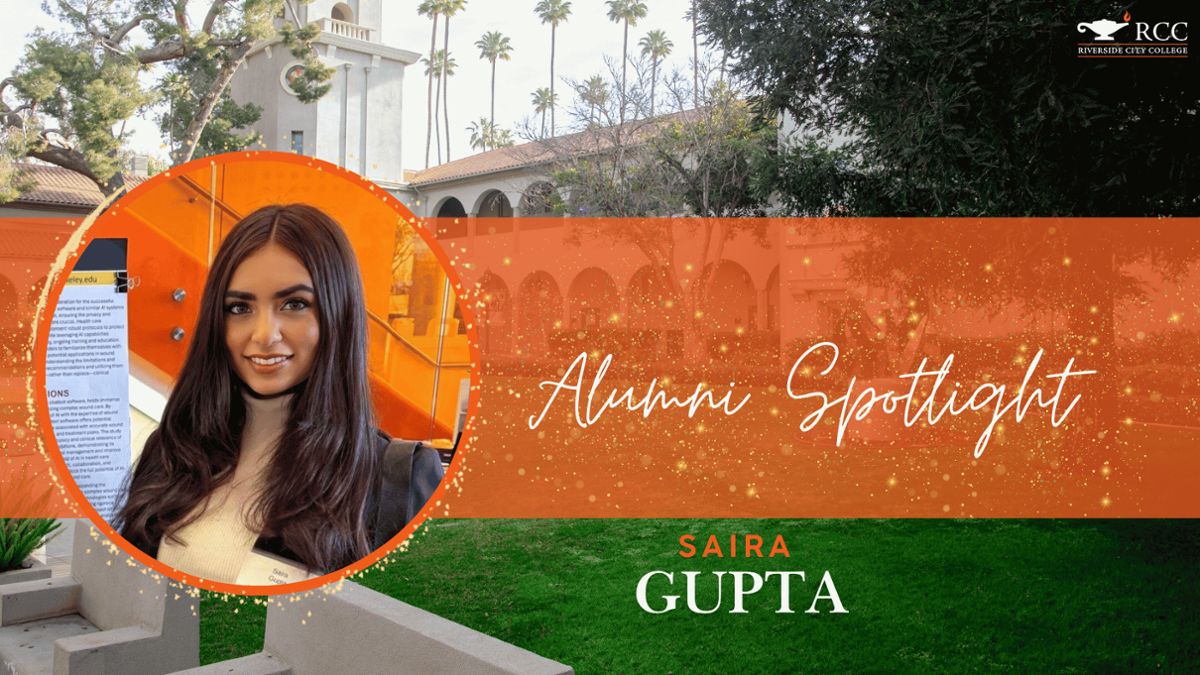
Saira Gupta’s path to medicine began early, but what defines it now is not speed alone. It is the way she learned to build a path before every step was clear.
Through Riverside STEAM Academy’s dual-enrollment program, Gupta began taking classes at Riverside City College while completing her high school requirements. Within a year, she had earned her high school diploma, completed enough coursework to apply, and move from RCC to a four-year university. Now a recent UC Berkeley graduate, she is preparing to begin medical school at Yale University, carrying with her a story shaped by agency, resilience, mentorship, and a growing interest in how science reaches people.
Gupta’s academic journey began with curiosity rather than a fixed roadmap. While participating in dual enrollment, she attended RCC classes while still completing high school requirements. At the time, she was drawn broadly to the life sciences and healthcare, but at RCC she was first able to explore how those interests connected to larger questions about people, systems, and care.
“RCC gave me the chance to understand medicine from multiple angles: the science, the human context, and the way people communicate and experience care,” Gupta said. “That breadth helped me realize that medicine was where my interests came together: rigorous science, human complexity, and service.”
At RCC, Gupta was not only navigating an accelerated academic path. She also served as a biology tutor and student group leader, helping peers work through the same material she was mastering herself. The experience became an early lesson in communication, mentorship, and leadership.
The accelerated path required more than academic ability. Gupta managed a rigorous course load while deliberately aligning her classes with UC transfer requirements. Within a year, she had built the academic foundation to transfer to a four-year university.
“RCC was where I first learned how to build a path before every step was obvious,” she said. “That required agency, mentorship, and a willingness to make decisions inside uncertainty.”
Her advice now is rooted in that experience.
“Uncertainty does not disappear as the stakes get higher,” Gupta said. “You have to learn how to think clearly, ask for advice, and make thoughtful decisions within it.”
After RCC, Gupta transferred to UC Berkeley, entering a larger and more complex academic environment. There, she studied Molecular and Cell Biology with an emphasis in Molecular Therapeutics and continued developing an interest in how scientific discoveries move from laboratories into real-world care.
At Berkeley, Gupta explored the path from science to implementation. Through the university’s Molecular Therapeutics Initiative and her work with Molecular Frontiers, she helped translate emerging therapeutics and drug discovery topics for scientific, clinical, industry, and public audiences.
Her interest in healthcare access also led her into entrepreneurship. Gupta co-founded and led PlatterPals, an allergy-focused dining platform that reached more than 1,000 users across the U.S. and Canada. Through interviews and conversations with restaurant owners and kitchen staff, she studied workflows, identified common failure points, and helped develop allergen-safety practices.
“PlatterPals taught me that healthcare innovation depends on trust and implementation,” Gupta said. “A good idea only matters if people can use it in the reality of their daily lives.”
She later brought that builder’s mindset into the classroom, designing and teaching UC Berkeley courses on startup building and biotech commercialization. The courses introduced students to topics ranging from drug discovery to venture formation and guided them through building and pitching early-stage ideas.
For Gupta, these experiences are connected by a common question: how does knowledge become useful to people?
Now preparing to begin medical school at Yale, Gupta said she was drawn to the university’s flexible curriculum and emphasis on student autonomy. She is entering medical school with an open mind and a current interest in surgical fields, but her larger focus is on understanding how medicine, science, and systems intersect.
“I’m interested in the full path from discovery to delivery: how science becomes medicine, how medicine reaches people, and how systems can be built to do that better,” she said.
Despite an accelerated academic path, Gupta remains closely connected to her family. A longstanding tradition of weekly Sunday Zoom calls has helped bridge distance and time zones, especially as she and her brother pursued different educational and professional paths.
As she prepares for Yale, Gupta sees RCC not simply as a stepping stone, but as the place where she first learned to build with intention. She credits supportive faculty, particularly instructors in chemistry, biology, and anthropology, with helping her develop both academic confidence and broader judgment.
“RCC taught me agency, resilience, and perseverance, not as innate traits but as habits you build by showing up, asking questions, and taking ownership of your path,” she said.
Her message to current and future RCC students is simple: seek mentors early and take those relationships seriously.
“Talk to your professors. Go to office hours. You’ll learn more than just the material—you’ll get wisdom that stays with you.”
For Gupta, RCC was not simply where her academic journey accelerated. It was where she first learned how to build one.
